Culture / Exhibition guide
At The Met, Tiffany begins with a drawing
A new exhibition puts the studio’s working ideas in focus. A small glass vessel offers a second way to look.
Before a Tiffany window could transform a room, somebody had to work out its design. The Met’s new exhibition, Designing the Gilded Age: Drawings from the Studios of Louis C. Tiffany, makes that earlier stage the destination. It runs through Feb. 7, 2027, in Galleries 691 to 693 at Fifth Avenue.
The museum brings together nearly 120 works from its collection with selected loans. The subject is a collaborative studio, not simply a famous signature: drawings for windows, lamps, mosaics and interiors offer a way to consider how an idea becomes something built. Rather than treating a drawing as a lesser version of a finished object, give it the first and longest look.
Try a small exercise. Choose one design and decide what you notice before reading its label. Is it a division of space, a repeated shape or a change in color? Then read for the intended object and setting. The difference between those two encounters can be the most useful part of the visit. You are comparing an immediate response with a practical purpose, not taking an art history exam.
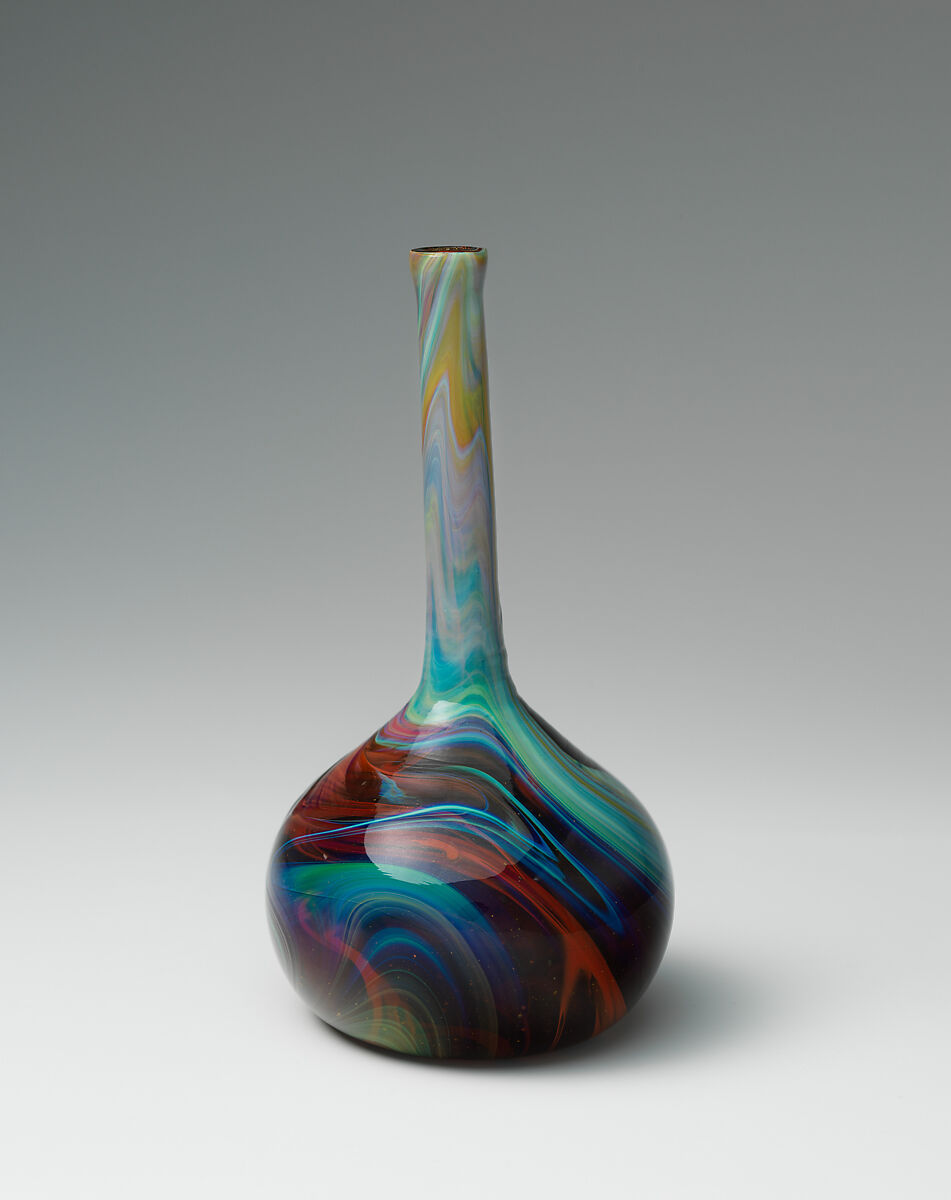
For a separate collection stop, The Met currently lists a Tiffany Favrile glass vase from 1893 to 1896 in Gallery 454. The small vessel pictured here belongs to that collection display, not to the drawing exhibition. Its rounded body and rippling color make a useful counterpoint: after looking at ideas on paper, consider what happens when color occupies a curved surface. Check the gallery’s availability on the day.
The Met Fifth Avenue is closed Wednesdays, so this is a plan for Thursday or later, not an invitation to arrive today. Regular Friday and Saturday hours extend to 9 p.m.; Thursday closes at 5 p.m. The address is 1000 Fifth Ave. Admission includes exhibitions. Standard adult admission is $30, with separate rates and eligibility rules for other visitors, including admission at an amount chosen by New York state residents.
Keep the route modest: the exhibition, one collection stop and enough time to look without rushing. A museum afternoon becomes more memorable when it has a question to carry through the rooms. Here, that question might be how much of a finished object was already present in the drawing, and how much belongs to the material itself.